
Overview
VibeTech provides multi-location vibration monitoring for bridges, floors, platforms, supports, and other structures. Studies can capture ambient response, traffic or equipment-related vibration, transient events, and changes occurring throughout an operational period.
The measurement infrastructure, documented sensor configuration, processed results, and raw waveform data can be supplied to qualified professionals for advanced analysis, including operational modal analysis where acquisition and timing requirements are met, analytical-model correlation, load-rating support, and long-term structural-health monitoring.
Measurement package
- 01Time histories and RMS trendsStudy configured
- 02Frequency-spectrum analysisStudy configured
- 03Scheduled and transient event capturesStudy configured
- 04Event classification and comparisonStudy configured
- 05Location-to-location response comparisonsStudy configured
- 06High-accuracy temperature and relative-humidity monitoring documented alongside operational and weather contextStudy configured
- 07Exportable raw waveform dataStudy configured
Field examples
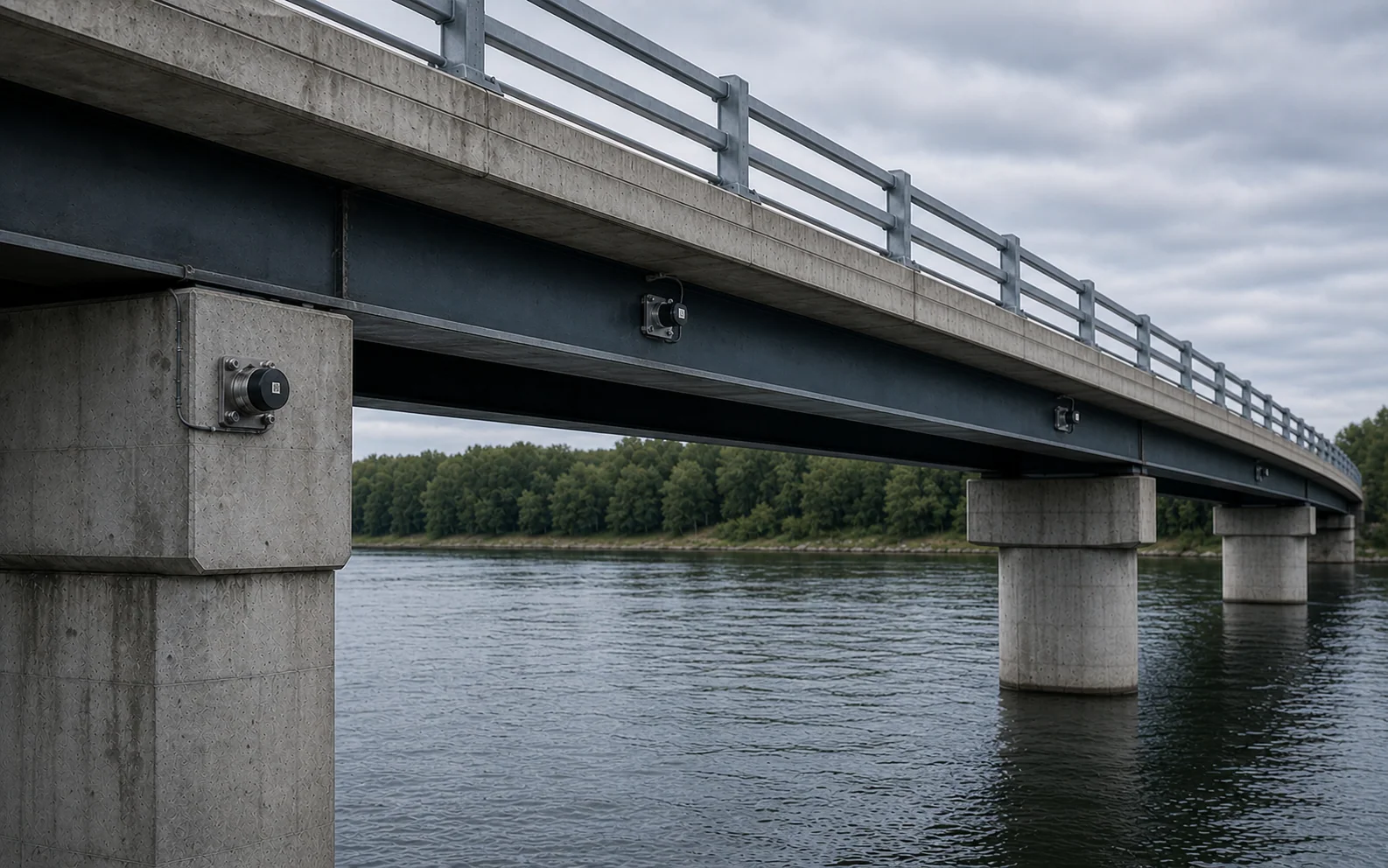
Documented sensor positions create an auditable relationship between each waveform and its physical bridge location, enabling meaningful comparison of supports, spans, and measurement directions.
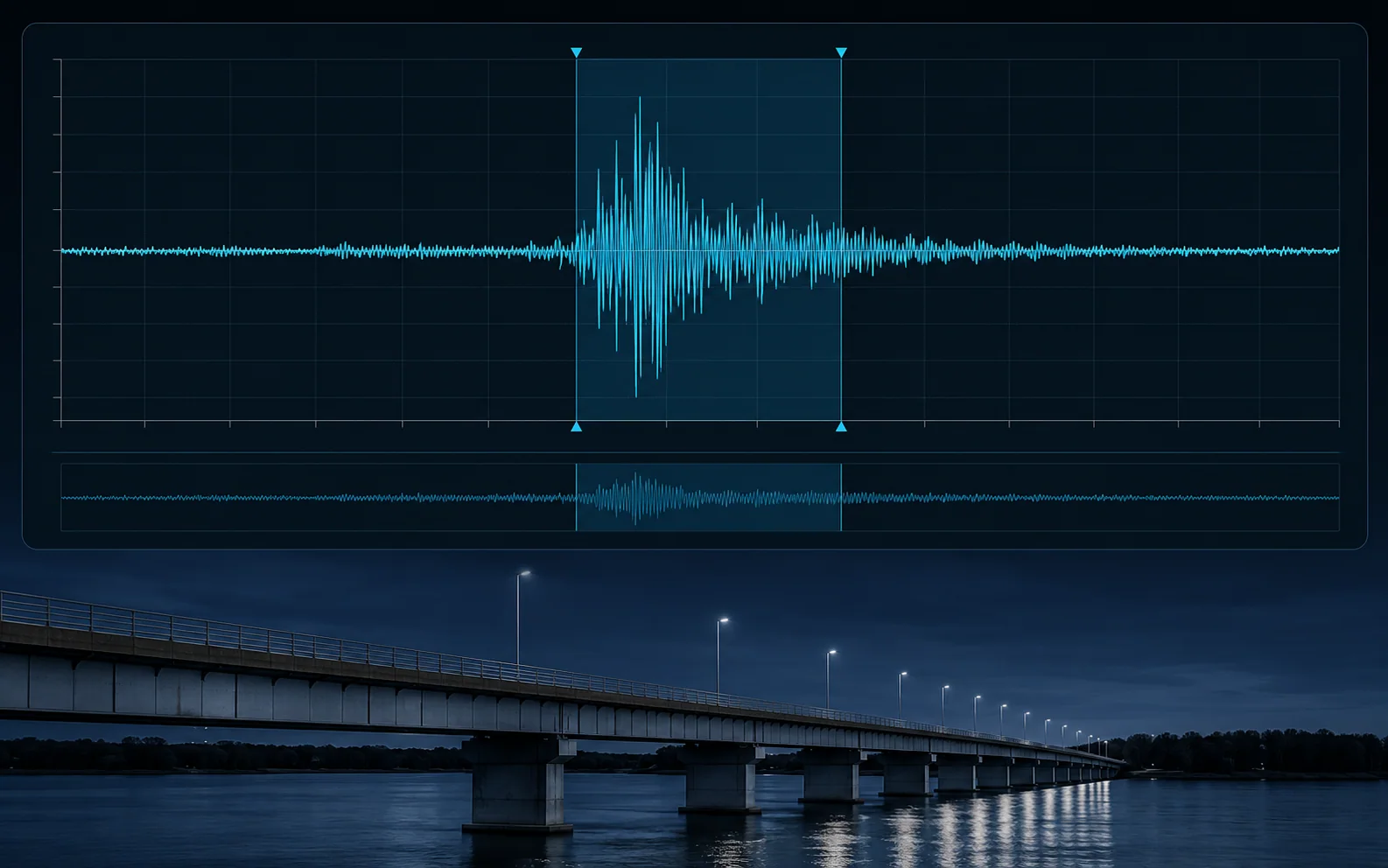
A time-history event window isolates structural response associated with a defined period of activity, allowing comparison of onset, peak response, and decay instead of relying on one overall value.
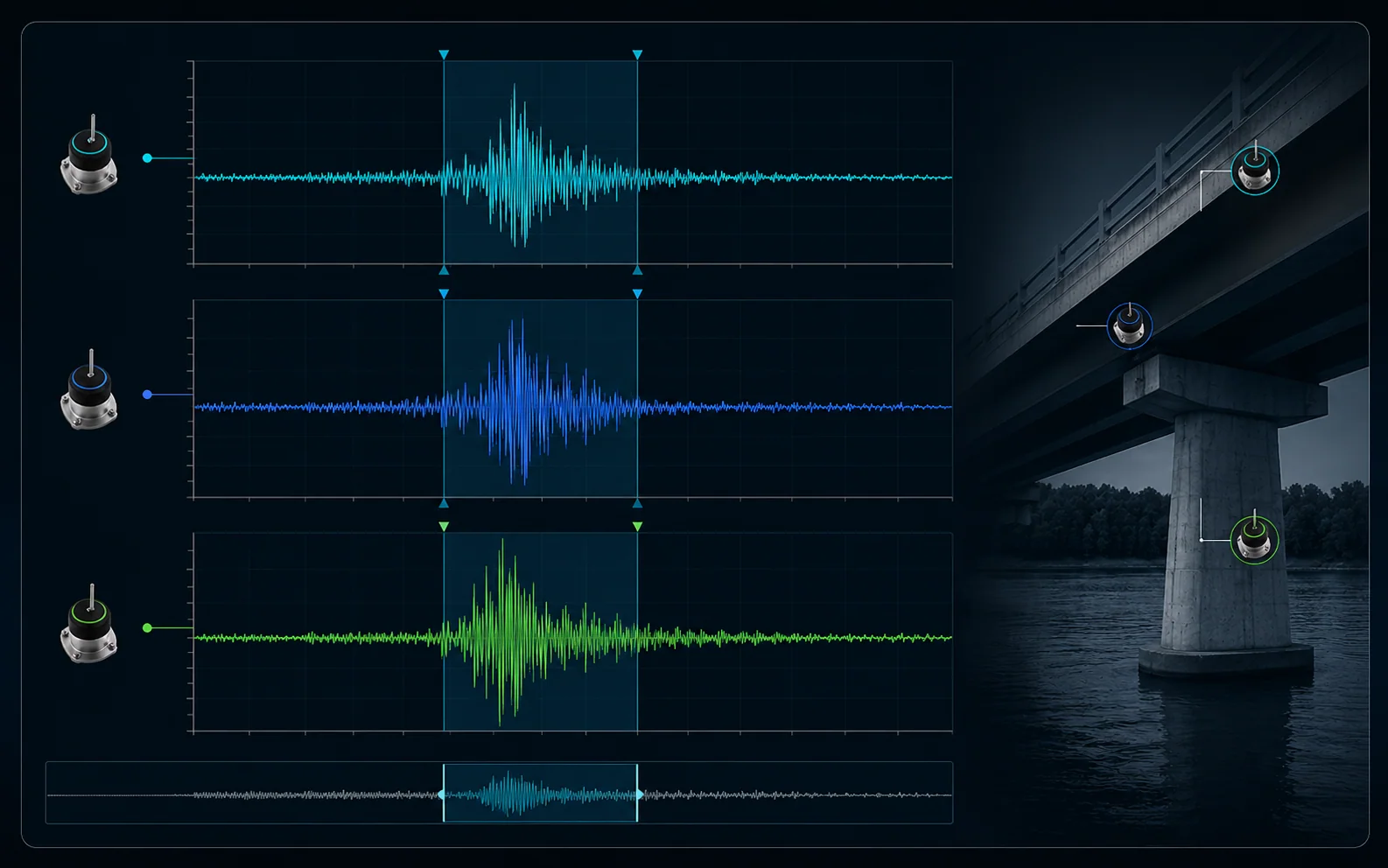
Time-aligned waveforms expose differences in amplitude, arrival, and decay across documented bridge locations, providing focused evidence for deeper structural review.
Service modes
Operational Response Screening
Documents vibration behavior under normal environmental and operating conditions.
Engineer-Directed Measurement Support
Collects data according to a monitoring plan developed by a licensed engineer or structural specialist.
Applications
What the evidence can support
Document ambient and operational response
Compare measured behavior across structural locations
Characterize traffic or equipment-related events
Supply evidence for model correlation
Support long-term monitoring programs
Provide data for qualified professional review
Every reported result remains linked to the sensor identity, documented location, collection time, measurement configuration, operating context, and underlying waveform data.
Scope boundary
Measured evidence, stated responsibly.
Operational response screening is not a bridge inspection, structural load rating, proof-load test, modal certification, or determination of structural safety. Those conclusions require evaluation by an appropriately qualified professional.